This is default featured slide 1 title

Go to Blogger edit html and find these sentences.Now replace these sentences with your own descriptions.

This is default featured slide 2 title

Go to Blogger edit html and find these sentences.Now replace these sentences with your own descriptions.

This is default featured slide 4 title

Go to Blogger edit html and find these sentences.Now replace these sentences with your own descriptions.

This is default featured slide 5 title

Go to Blogger edit html and find these sentences.Now replace these sentences with your own descriptions.

Showing posts with label developed. Show all posts

7 Jun 2013

WhatsApp


WhatsApp Messenger screenshot.jpg
WhatsApp Messenger 2.8.2 running on iOS

WhatsApp


Developer(s) WhatsApp Inc.
Stable release Android
2.9.5196 (May 16, 2013; 22 days ago)
Android
2.9.7312 (May 21, 2013; 17 days ago)
BlackBerry OS
2.9.874 (January 25, 2013; 4 months ago)
BlackBerry 10
2.10.8002.1 (June 4, 2013; 3 days ago)
iOS
2.8.7 (December 7, 2012; 5 months ago)
Nokia Symbian (S60)
2.10.163 (May 29, 2013; 9 days ago)
Nokia Series 40
2.4.21 (April 23, 2013; 45 days ago)
Windows Phone
2.9.4 (February 24, 2013; 3 months ago)
Development status Active
Operating system Android, BlackBerry OS, BlackBerry 10, iOS, Series 40, Symbian and Windows Phone
Type Instant Messaging
Licence Proprietary
Website whatsapp.com

WhatsApp Messenger is a proprietary, cross-platform instant messaging application for smartphones. In addition to text messaging, users can send each other images, video, and audio media messages. The client software is available for Android, BlackBerry OS, BlackBerry 10, iOS, Series 40, Symbian (S60), and Windows Phone. WhatsApp Inc. was founded in 2009 by Brian Acton and Jan Koum, both veterans of Yahoo!, and is based in Santa Clara, California.
Competing with a number of Asian-based messaging services (like LINE, KakaoTalk, and WeChat), WhatsApp was handling ten billion messages per day as of August 2012, growing from two billion in April 2012 and one billion the previous October. According to the Financial Times, WhatsApp "has done to SMS on mobile phones what Skype did to international calling on landlines."

Technical

WhatsApp uses a customized version of the open standard Extensible Messaging and Presence Protocol (XMPP). Upon installation, it creates a user account using one's phone number as username (Jabber ID: [phone number]@s.whatsapp.net). WhatsApp software automatically compares all the phone numbers from the device's address book with its central database of WhatsApp users to automatically add contacts to the user's WhatsApp contact list. Previously the Android and S40 versions used an MD5-hashed, reversed-version of the phone's IMEI as password, while the iOS version used the phone's Wi-Fi MAC address instead of IMEI. A recent update now generates a random password on the server side.
Multimedia messages are sent by uploading the image, audio or video to be sent to a HTTP server and then sending a link to the content along with its Base64 encoded thumbnail (if applicable).
Until August 2012, messages were sent in unencrypted plain-text format, making the system vulnerable to session hijacking. As of August 15, 2012, the WhatsApp support staff claim messages are encrypted in the "latest version" of the WhatsApp software for iOS and Android (not including BlackBerry, Windows Phone and Symbian), without specifying the implemented cryptographic method.


Security

In May 2011, a security hole was reported in WhatsApp which left user accounts open for hijacking. Since May 2011, it has been reported that communications made by WhatsApp are not encrypted, and data is sent and received in plaintext, meaning messages can easily be read if packet traces are available
According to some sources, it is believed that the hijacking hack was performed, and later fixed by helping WhatsApp reproduce it on Android and Symbian, by Liroy van Hoewijk, CEO of CoreISP.net. Then, in May 2012 security researchers noted that new updates of WhatsApp no longer sent messages as plaintext, however, the cryptographic method implemented was subsequently described as "broke
In September 2011, a new version of the WhatsApp Messenger application for iPhones was released. In this new version, the developer has closed a number of critical security holes that allowed forged messages to be sent and messages from any WhatsApp user to be read
On January 6, 2012, an unknown hacker published a website (WhatsAppStatus.net) which made it possible to change the status of an arbitrary WhatsApp user, as long as the phone number was known. To let it work, it only required a restart of the app. According to the hacker, it is only one of the many security issues in WhatsApp. On January 9, WhatsApp reported to have solved the issue. In reality, the only measure that was taken was blocking the website's IP address. As a reaction, a Windows tool was made available for download providing the same functionality. This issue has since been resolved in the form of an IP check on currently logged in session.
On January 13, 2012, WhatsApp was pulled from the iOS App Store. The reason was not disclosed. The app was added back to the App Store four days later.
Using WhatsAPI, German Tech site The H demonstrated how to hijack any WhatsApp account on September 14, 2012. Shortly after a legal threat to WhatsAPI's developers was alleged, characterized by The H as "an apparent reaction" to security reports, and WhatsAPI's source code was taken down. The WhatsAPI team has since returned to active development.

Privacy

Another issue was witnessed on November 28, 2012 and before (WA blog post about it is from January 12), though this is not a security concern at all but more a problem with "chain messages", when users got spam messages and ignorantly forwarded hoax messages to people on their contact lists. The WhatsApp team clearly mentioned on its website that all such messages are fake This has not been the work of hackers, but simply the work of people randomly forwarding nonsense, a problem on any social media.
A major privacy and security issue has been the subject of a joint Canadian-Dutch government investigation. The primary concern was that WhatsApp required users to upload their entire mobile phone's address book to WhatsApp servers so that WhatsApp could discover who, among the users' existing contacts, is available via WhatsApp. While this is a fast and convenient way to quickly find and connect the user with contacts who are also using WhatsApp, it means that their address book was then mirrored on the WhatsApp servers, including contact information for contacts who are not using WhatsApp. However, this information was stored as a hash and without additional identifying information such as a name.
On March 31, 2013, the governing body of telecommunications affairs in Saudi Arabia, the Communications and Information Technology Commission (CITC), issued a statement regarding possible measures against WhatsApp, among other applications, unless the service providers took serious steps in order to comply with monitoring and privacy regulations.

Windows Phone


Windows Phone 8 logo and wordmark (purple).svg

Company / developer Microsoft Corporation
Programmed in C, C++
OS family Windows
Working state Current
Source model Closed-source
Initial release
  • NA November 8, 2010
  • PAL October 21, 2010
  • EU October 21, 2010
Latest stable release Windows Phone 8 (8.0.10211.204) / December 20, 2012
Available language(s) 25+ languages
Package manager Windows Phone Store
XAP on Windows Phone 8 and later
Supported platforms Qualcomm Snapdragon (Based on ARM V.7 or later)
Kernel type Monolithic (Windows CE) (Windows Phone 7)
Hybrid (Windows NT) (Windows Phone 8)
Default user interface Graphical (Metro UI)
License Commercial proprietary software
Official website   www.windowsphone.com


   Windows Phone (abbreviated as WP) is a series of proprietary mobile operating systems developed by Microsoft, and is the successor to its Windows Mobile platform, although incompatible with it. Unlike its predecessor, it is primarily aimed at the consumer market rather than the enterprise market. It was first launched in October 2010, with a release in Asia following in early 2011.
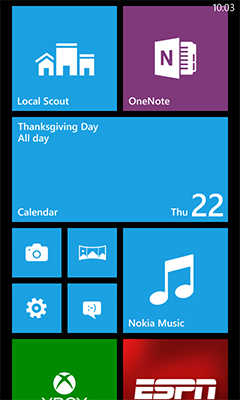
The latest release of Windows Phone is Windows Phone 8, which has been available to consumers since October 29, 2012. With Windows Phone, Microsoft created a new user interface, featuring its design language called the Modern design language. Additionally, the software is integrated with third party services and Microsoft services, and sets minimum requirements for the hardware on which it runs.
Microsoft is currently developing the next version of Windows Phone, code named "Windows Phone Blue" (previously "Windows Phone Apollo Plus") which will either be named Windows Phone 8.1 or Windows Phone 9

Launch and expansion

Windows Phone 7

Windows Phone 7 logo
Windows Phone 7 was announced at Mobile World Congress in Barcelona, Spain, on February 15, 2010, and released publicly on November 8, 2010 in the United States.
Microsoft released an updated version of Windows Phone 7, Mango (also referred to as Windows Phone 7.5), in May 2011. The update included a mobile version of Internet Explorer 9 that supports the same web standards and graphical capability as the desktop version, multi-tasking of third-party apps, Twitter integration for the People Hub, and Windows Live SkyDrive access
A minor update released in 2012 known as "Tango", along with other bug fixes, lowered the hardware requirements to allow for devices with 800 MHz CPUs and 256 MB of RAM to run Windows Phone.
In January 2013, Windows Phone 7.8 was released. It added some features from Windows Phone 8, such as an updated start screen, doubling of the color scheme options to 20 and the option to have the Bing image of the day as the lock screen wallpaper. Windows Phone 7.8 was intended to prolong the life of older Windows Phone 7 devices, as these were not upgradable to Windows Phone 8 due to hardware limitations. However, not all users have received the Windows Phone 7.8 update yet.
Microsoft has announced that Windows Phone 7.8 will see further future updates and as both Windows Phone 7 and Windows Phone 8 will coexist for sometime, to support devices in different price ranges.

Windows Phone 8

Three high-end Windows Phone 8 devices from left to right: HTC 8X, Lumia 920, Lumia 820.
On October 29, 2012, Microsoft released Windows Phone 8, a new generation of the operating system. Windows Phone 8 replaces its previously Windows CE-based architecture with one based on the Windows NT kernel with many components shared with Windows 8, allowing applications to be easily ported between the two platforms.

Hardware support

Windows Phone 8, while adding a number of software improvements, also brought support for updated hardware. This included support for multi-core processors and high resolution screens. Windows Phone 7 and 7.5 were often criticized for a lack of high end hardware support, but Windows Phone 8's new hardware gave Windows Phone the ability to better compete with Google


Partnership with Nokia

On February 11, 2011, at a press event in London, Microsoft CEO Steve Ballmer and Nokia CEO Stephen Elop announced a partnership between their companies in which Windows Phone would become the primary smartphone operating-system for Nokia, replacing Symbian. The event focused largely on setting up "a new global mobile ecosystem", suggesting competition with Android and iOS with the words "It is now a three horse race". Elop's reasoning behind settling on Windows Phone over Android involved the realization: "the single most important word is 'differentiation'. Entering the Android environment late, we knew we would have a hard time differentiating." While Nokia would have had more long-term creative control with Android (note that MeeGo as used by Nokia resembles Android more than it does Windows Phone 7), Elop enjoyed familiarity with his past company where he had been a top executive.
The pair announced integration of Microsoft services with Nokia's own services; specifically:
The partnership involves "funds changing hands for royalties, marketing and ad-revenue sharing", which Microsoft later announced as "measured in billions of dollars."Jo Harlow, whom Elop tapped to run Nokia's smartphone business, rearranged her team to match the structure led by Microsoft's VP of Windows Phone, Terry Myerson. Myerson was quoted as saying "I can trust her with what she tells me. She uses that same direct and genuine communication to motivate her team.
The first Nokia Windows phones, the Lumia 800 and Lumia 710, were announced in October 2011 at Nokia World 2011 event.[
At the Consumer Electronics Show in 2012 Nokia announced the Lumia 900, featuring a 4.3-inch AMOLED ClearBlack display, a 1.4 GHz processor and 16 GB of storage.The Lumia 900 was one of the first Windows Phones to support LTE and was released on AT&T on April 8. An international version will launch in Q2 2012, with a UK launch expected in May. The Lumia 610 is the first Nokia Windows Phone to run the Tango Variant (Windows Phone 7.5 Refresh) and is aimed at emerging markets.


6 Jun 2013

Android (operating system)

Android 4.2 on the Nexus 4.png


Android (operating system)


Android robot.svg
Android.svg
The green Android logo, designed by graphic designer Irina Blok.

Android 4.2 "Jelly Bean" on the Nexus 4
Company / developer Google
Open Handset Alliance
Android Open Source Project
Programmed in C, C++, Java
OS family Unix-like
Working state Current
Source model Open source
Initial release September 23, 2008
Latest stable release 4.2.2 Jelly Bean / February 11, 2013; 3 months ago
Marketing target Smartphones
Tablet computers
Available language(s) Multi-lingual
Package manager Google Play, APK
Supported platforms ARM, MIPS, x86, I.MX
Kernel type Monolithic (modified Linux kernel)
Default user interface Graphical (Multi-touch)
License Apache License 2.0
Linux kernel patches under GNU GPL v2
Official website www.android.com 


Android is a Linux-based operating system designed primarily for touchscreen mobile devices such as smartphones and tablet computers. Initially developed by Android, Inc., which Google backed financially and later bought in 2005,Android was unveiled in 2007 along with the founding of the Open Handset Alliance: a consortium of hardware, software, and telecommunication companies devoted to advancing open standards for mobile devices. The first Android-powered phone was sold in October 2008.
Android is open source and Google releases the code under the Apache License. This open source code and permissive licensing allows the software to be freely modified and distributed by device manufacturers, wireless carriers and enthusiast developers. Additionally, Android has a large community of developers writing applications ("apps") that extend the functionality of devices, written primarily in a customized version of the Java programming language. In October 2012, there were approximately 700,000 apps available for Android, and the estimated number of applications downloaded from Google Play, Android's primary app store, was 25 billion.
These factors have contributed towards making Android the world's most widely used smartphone platform, overtaking Symbian in the fourth quarter of 2010, and the software of choice for technology companies who require a low-cost, customizable, lightweight operating system for high tech devices without developing one from scratch.As a result, despite being primarily designed for phones and tablets, it has seen additional applications on televisions, games consoles, digital cameras and other electronics. Android's open nature has further encouraged a large community of developers and enthusiasts to use the open source code as a foundation for community-driven projects, which add new features for advanced users or bring Android to devices which were officially released running other operating systems.
Android had a worldwide smartphone market share of 75% during the third quarter of 2012, with 750 million devices activated in total and 1.5 million activations per day.The operating system's success has made it a target for patent litigation as part of the so-called "smartphone wars" between technology companies. As of May 2013, a total of 900 million Android devices have been activated and 48 billion apps have been installed from the Google Play store.

History

Android, Inc. was founded in Palo Alto, California in October 2003 by Andy Rubin (co-founder of Danger), Rich Miner (co-founder of Wildfire Communications, Inc.), Nick Sears (once VP at T-Mobile), and Chris White (headed design and interface development at WebTV)to develop, in Rubin's words "smarter mobile devices that are more aware of its owner's location and preferences". The early intentions of the company were to develop an advanced operating system for digital cameras, when it was realised that the market for the devices was not large enough, and diverted their efforts to producing a smartphone operating system to rival those of Symbian and Windows Mobile (Apple's iPhone had not been released at the time). Despite the past accomplishments of the founders and early employees, Android Inc. operated secretly, revealing only that it was working on software for mobile phones. That same year, Rubin ran out of money. Steve Perlman, a close friend of Rubin, brought him $10,000 in cash in an envelope and refused a stake in the company.
Google acquired Android Inc. on August 17, 2005, making it a wholly owned subsidiary of Google. Key employees of Android Inc., including Rubin, Miner and White, stayed at the company after the acquisition. Not much was known about Android Inc. at the time, but many assumed that Google was planning to enter the mobile phone market with this move. At Google, the team led by Rubin developed a mobile device platform powered by the Linux kernel. Google marketed the platform to handset makers and carriers on the promise of providing a flexible, upgradable system. Google had lined up a series of hardware component and software partners and signaled to carriers that it was open to various degrees of cooperation on their part.
Speculation about Google's intention to enter the mobile communications market continued to build through December 2006. Reports from the BBC and the Wall Street Journal noted that Google wanted its search and applications on mobile phones and it was working hard to deliver that. Print and online media outlets soon reported rumors that Google was developing a Google-branded handset. Some speculated that as Google was defining technical specifications, it was showing prototypes to cell phone manufacturers and network operators. In September 2007, InformationWeek covered an Evalueserve study reporting that Google had filed several patent applications in the area of mobile telephony.
On November 5, 2007, the Open Handset Alliance, a consortium of technology companies including Google, device manufacturers such as HTC and Samsung, wireless carriers such as Sprint Nextel and T-Mobile, and chipset makers such as Qualcomm and Texas Instruments, unveiled itself, with a goal to develop open standards for mobile devices. That day, Android was unveiled as its first product, a mobile device platform built on the Linux kernel version 2.6. The first commercially available phone to run Android was the HTC Dream, released on October 22, 2008.
Since 2008, Android has seen numerous updates which have incrementally improved the operating system, adding new features and fixing bugs in previous releases. Each major release is named in alphabetical order after a dessert or sugary treat; for example, version 1.5 Cupcake was followed by 1.6 Donut. The latest release is 4.2 Jelly Bean. In 2010, Google launched its Nexus series of devices—a line of smartphones and tablets running the Android operating system, and built by a manufacturer partner. HTC collaborated with Google to release the first Nexus smartphone,the Nexus One. The series has since been updated with newer devices, such as the Nexus 4 phone and Nexus 10 tablet, made by LG and Samsung, respectively. Google releases the Nexus phones and tablets to act as their flagship Android devices, demonstrating Android's latest software and hardware features.
On 13 March 2013, it was announced by Larry Page in a blog post that Andy Rubin had moved from the Android division to take on new projects at Google. He was replaced by Sundar Pichai, who also continues his role as the head of Google's Chrome division, which develops Chrome OS.

Applications

Android has a growing selection of third party applications, which can be acquired by users either through an app store such as Google Play or the Amazon Appstore, or by downloading and installing the application's APK file from a third-party site. The Play Store application allows users to browse, download and update apps published by Google and third-party developers, and is pre-installed on devices that comply with Google's compatibility requirements.The app filters the list of available applications to those that are compatible with the user's device, and developers may restrict their applications to particular carriers or countries for business reasons. Purchases of unwanted applications can be refunded within 15 minutes of the time of download, and some carriers offer direct carrier billing for Google Play application purchases, where the cost of the application is added to the user's monthly bill.As of September 2012, there were more than 675,000 apps available for Android, and the estimated number of applications downloaded from the Play Store was 25 billion.
Applications are developed in the Java language using the Android software development kit (SDK). The SDK includes a comprehensive set of development tools, including a debugger, software libraries, a handset emulator based on QEMU, documentation, sample code, and tutorials. The officially supported integrated development environment (IDE) is Eclipse using the Android Development Tools (ADT) plugin. Other development tools are available, including a Native Development Kit for applications or extensions in C or C++, Google App Inventor, a visual environment for novice programmers, and various cross platform mobile web applications frameworks.
In order to work around limitations on reaching Google services due to Internet censorship in the People's Republic of China, Android devices sold in the PRC are generally customized to use state approved services instead.


Usage share of Android versions

Usage share of the different versions collected during a 14-day period ending on May 1, 2013
 
Usage share of the different versions as of June 3, 2013.[158]
Version Code name Release date API level Distribution (May 1, 2013)
4.2.x Jelly Bean November 13, 2012 17 4.0%
4.1.x Jelly Bean July 9, 2012 16 29.0%
4.0.x Ice Cream Sandwich December 16, 2011 15 25.6%
3.2 Honeycomb July 15, 2011 13 0.1%
3.1 Honeycomb May 10, 2011 12
2.3.3–2.3.7 Gingerbread February 9, 2011 10 36.4%
2.3–2.3.2 Gingerbread December 6, 2010 9 0.1%
2.2 Froyo May 20, 2010 8 3.2%
2.0–2.1 Eclair October 26, 2009 7 1.5%
1.6 Donut September 15, 2009 4 0.1%
1.5 Cupcake April 30, 2009 3


5 Jun 2013

iOS


IOS 6 Home Screen.png


 iOS 


Apple iOS.svg

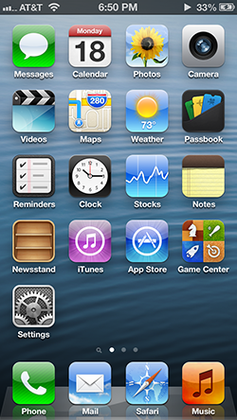
iOS 6 running on an iPhone 5
Company / developer Apple Inc.
Programmed in C, C++, Objective-C
OS family OS X, UNIX
Working state Current
Source model Closed source
Initial release July 29, 2007; 5 years ago
Latest stable release
iPhone 3GS, 4 and 4S
iPad 2, 3 and 4
iPad Mini
iPod Touch 4th and 5th generations
6.1.3 (Build 10B329) (March 19, 2013; 2 months ago)
iPhone 5
6.1.4 (Build 10B350) (May 2, 2013; 34 days ago)
Apple TV 2nd and 3rd generations
5.2.1 (Build 10B329a) (March 19, 2013; 2 months ago)
Available language(s) 34 languages
Package manager .deb
Supported platforms ARM (iPhone, iPod Touch, iPad, iPad Mini, and 2nd gen. and higher Apple TV), Apple A4, Apple A5, Apple A5X, Apple A6, Apple A6X
Kernel type Hybrid (XNU)
Default user interface Cocoa Touch (multi-touch, GUI)
License Proprietary EULA except for open-source components
Official website www.apple.com/ios/

iOS (previously iPhone OS) is a mobile operating system developed and distributed by Apple Inc. Originally unveiled in 2007 for the iPhone, it has been extended to support other Apple devices such as the iPod touch (September 2007), iPad (January 2010) and Apple TV (second generation) (September 2010). Unlike Microsoft's Windows Phone and Google's Android, Apple does not license iOS for installation on non-Apple hardware. As of January 2013, Apple's App Store contained more than 775,000 iOS applications, 300,000 of which were optimised for iPad. These apps have collectively been downloaded more than 50 billion times. It had a 21% share of the smartphone mobile operating system units shipped in the fourth quarter of 2012, behind only Google's Android. In June 2012, it accounted for 65% of mobile web data consumption (including use on both the iPod Touch and the iPad). At the half of 2012, there were 410 million devices activated. According to the special media event held by Apple on September 12, 2012, 400 million devices have been sold through June 2012.
The user interface of iOS is based on the concept of direct manipulation, using multi-touch gestures. Interface control elements consist of sliders, switches, and buttons. Interaction with the OS includes gestures such as swipe, tap, pinch, and reverse pinch, all of which have specific definitions within the context of the iOS operating system and its multi-touch interface. Internal accelerometers are used by some applications to respond to shaking the device (one common result is the undo command) or rotating it in three dimensions (one common result is switching from portrait to landscape mode).
iOS is derived from OS X, with which it shares the Darwin foundation. iOS is Apple's mobile version of the OS X operating system used on Apple computers.
In iOS, there are four abstraction layers: the Core OS layer, the Core Services layer, the Media layer, and the Cocoa Touch layer. The current version of the operating system (iOS 6.1.3) dedicates 1-1.5 GB of the device's flash memory for the system partition, using roughly 800 MB of that partition (varying by model) for iOS itself.
iOS currently runs on iPhone, iPad, iPod touch and Apple TV.

History

The operating system was unveiled with the iPhone at the Macworld Conference & Expo, January 9, 2007, and released in June of that year. At first, Apple marketing literature did not specify a separate name for the operating system, stating simply that the "iPhone runs OS X". Initially, third-party applications were not supported. Steve Jobs' reasoning was that developers could build web applications that "would behave like native apps on the iPhone". On October 17, 2007, Apple announced that a native Software Development Kit (SDK) was under development and that they planned to put it "in developers' hands in February".On March 6, 2008, Apple released the first beta, along with a new name for the operating system: "iPhone OS".

Software updates

Apple provides major updates to the iOS operating system approximately once a year over iTunes and also, since iOS version 5.0, over the air. The latest major update is iOS 6, publicly announced on June 11, 2012 and released on September 12, 2012. Over 200 new features debut in iOS 6, including Apple's new Passbook service, Apple-sourced Maps, and full Facebook integration.
Before iOS 4's release in 2010, iPod touch users had to pay for system software updates. Apple claimed that this was the case, because the iPod touch was not a 'subscription device' like the iPhone (i.e. it was a one-off purchase). Apple claimed it had 'found a way' to deliver software updates for free to iPod touch users at WWDC 2010, when iOS 4 was unveiled.

Folders

With iOS 4 came the introduction of a simple folder system. When applications are in "jiggle mode", any two (with the exception of Newsstand in iOS 5 and later, which acts like a folder) can be dragged on top of each other to create a folder, and from then on, more apps can be added to the folder using the same procedure, up to 12 on iPhone 4S and earlier and iPod touch, 16 on iPhone 5, and 20 on iPad. A title for the folder is automatically selected by the category of applications inside, but the name can also be edited by the user. When apps inside folders receive badges, the numbers shown by the badges is added up and shown on the folder. Folders can't be put into other folders, but through exploiting iOS glitches, Newsstand and other folders can be forced to be placed into a folder. This is handy for some users who find the Newsstand functionality useless. However, upon attempting to open a folder/the Newsstand within a folder, the SpringBoard will crash.

Notification Center

Before iOS 5, notifications were delivered in blue dialog box. This system of notification management was greatly criticised. In the iOS 5 update, the notifications feature was completely redesigned. Notifications collate in a window which can be dragged down from the top of the screen. If a user touches a received notification, the application that sent the notification will be opened. Notifications are now delivered in small banners that appear over the status bar. The old method of delivering notifications is still available from Notification Settings if the user wishes to enable it for some or all applications.
When an app sends a notification whilst closed, a red badge will appear on its icon. This badge tells the user, at a glance, how many notifications that app has sent. Opening the app clears the badge.

Included applications

The iOS home screen contains these default "apps". Some of these applications are hidden by default and accessed by the user through the Settings app or another method—for instance, Nike+iPod is activated through the Settings app. Many of these apps, such as Safari, the App Store, and YouTube, can also be disabled in the Restrictions section of the Settings app.


Deeksha. Powered by Blogger.